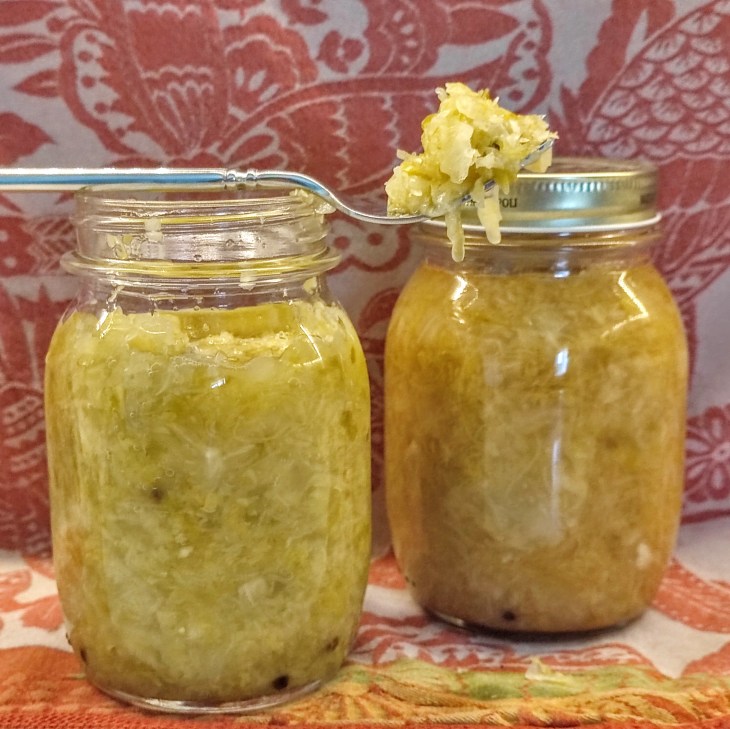
Who makes their own sauerkraut? I do, and I thought my grandmother did, too, but alas, no.
Warning: Use the “Jump to Recipe” button if you do not care about any of this. It’s important to me, so I thought I’d share. It’s worth the read and food for thought, plus I’m a funny person, so there’s that.
I was recently in Esztergom, Hungary and one of my hands-down favorite dishes was something I plan to recreate in an upcoming blog (a bean dish topped with sauerkraut). Making sauerkraut takes a good 7 – 10 days of fermenting so before sharing the bean recipe I wanted to give you a jump start on making your own kraut, should this post inspire you.


Many people do not like sauerkraut, especially if they have only had it from a can at room temperature. But homemade, and slightly warm? Dee-lish-us! Since I had not made homemade sauerkraut in ages, I searched through my Polish grandmother’s recipes but only found those using sauerkraut, not making sauerkraut itself.

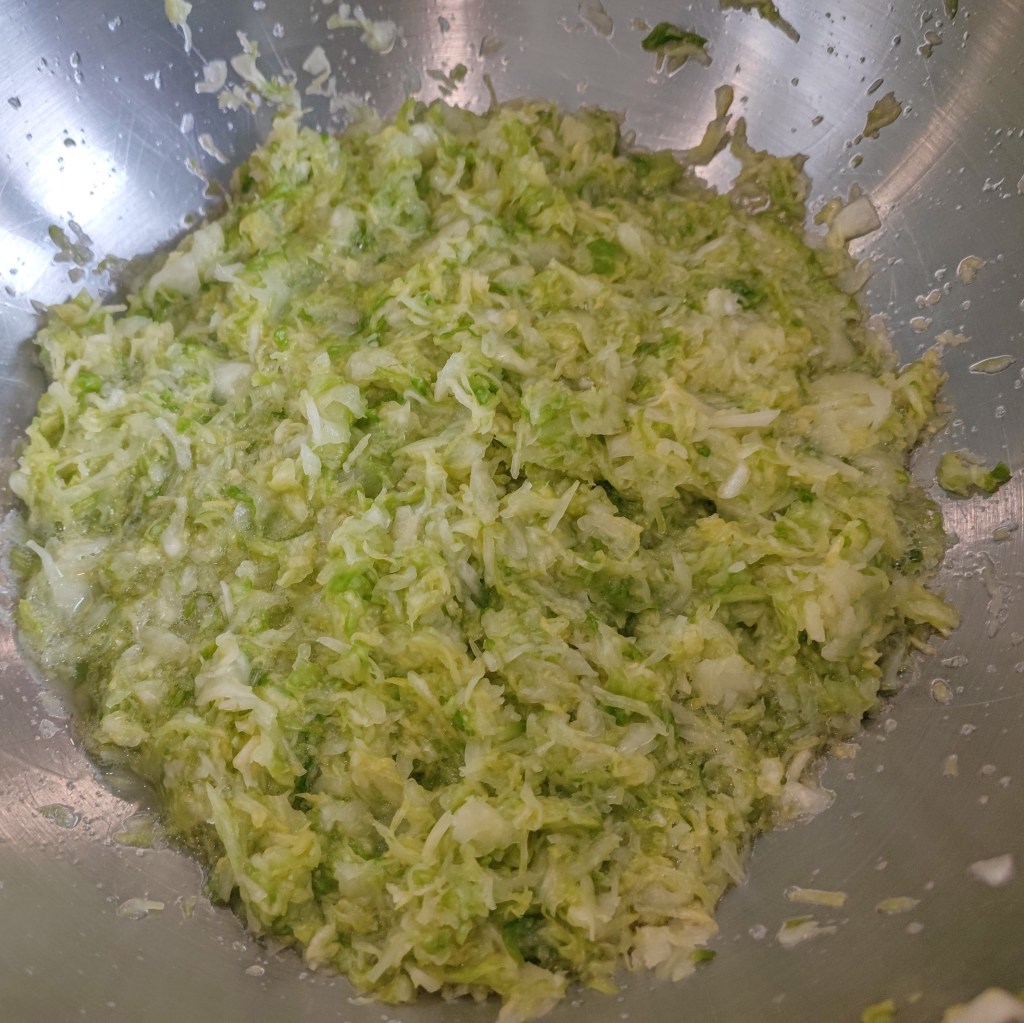
So, here comes the plagiarism part. If I do not develop a recipe 100% myself, when posting a recipe on GregNelsonCooks.com I credit the source and make a note of what I changed or simplified, if any. It has been happening with alarming frequency that when I search online for recipes, I find EXACTLY worded recipes from MULTIPLE bloggers, none of whom credit the original source. Such was the case when looking for a recipe for sauerkraut. (I have never written the word sauerkraut so many times in my life! At least now I know how to spell SAUERKRAUT)! Such blatant stealing of recipes (or any content) without citing or crediting the source is shocking and all too common these days. Are people really that attention, fame, fortune and advertising revenued-starved that they have to copy and paste others’ content?!


The most important thing I learned about making sauerkraut was getting the ratio of cabbage to salt correct. I’ll make a note of that in the recipe, below. Otherwise, if you want to add caraway seeds, use a bay leaf, or even add a pinch of smoke paprika at the end of your fermentation, it is up to you. To whom do I credit this recipe? Your guess is as good as mine since they are nearly identical. I will at least slim down the process steps in the recipe, below, to save you some time.
Arliano Update (Aggiornamento Arliano):
Our 10 sweet cherry trees have been picked clean by birds (well… the trees are picked clean, our sidewalks are full of cherry pits and bird poop). Not one landed in my mouth (the cherries, not the birds). The sour cherries, on the other hand, are glorious this year. Husband Tom picked a bowlful to make cherry liquor. Yum. Speaking of birds, the insane crows are back this year. You can read more about them here if you like reading a bit of Edgar Allen Poe-inspired tales.
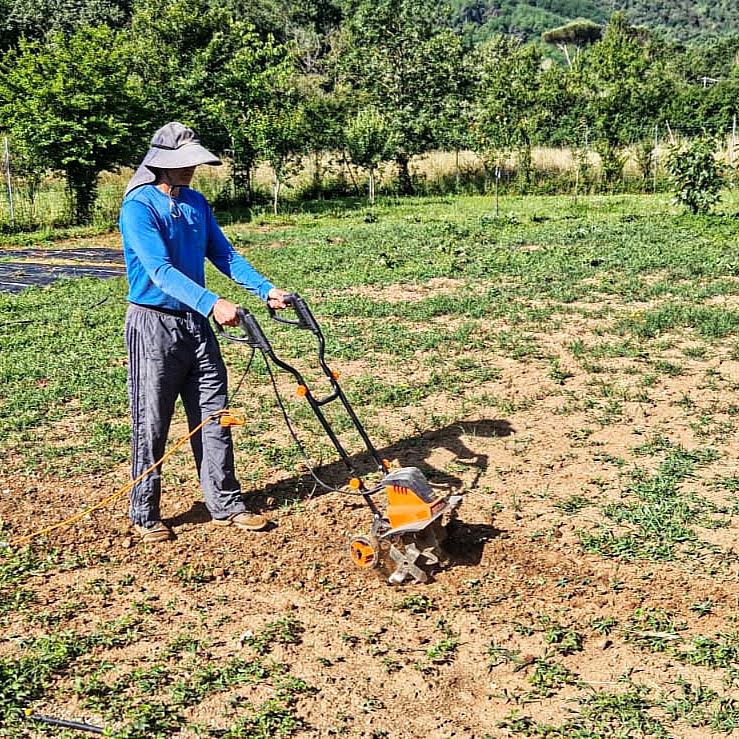

The garden is in full swing and already producing tons of weeds, my specialty. All 15 rows have been weed tarp blocked and planted. This is the first year I’m using weed blocking tarps, so I hope they are worth the money. Many of the seeds planted 2-3 weeks ago have germinated while others are still being shy. I’ll give them another week before re-planting. It’s looking like it’s going to be another hot windy summer so I’m watering everyday using the new irrigation hoses. Thanks to the heavy clay soil, by late afternoon the plowed rows look like cracked dry lake beds. Still, though, the moisture reader tool says there’s plenty of moisture just under the surface.
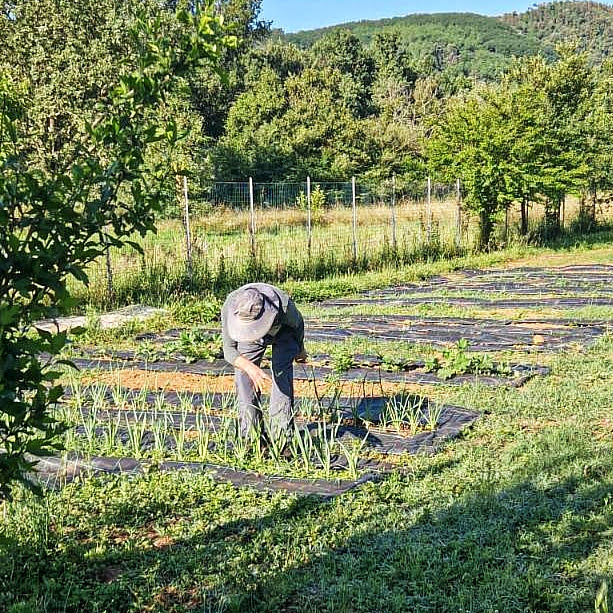
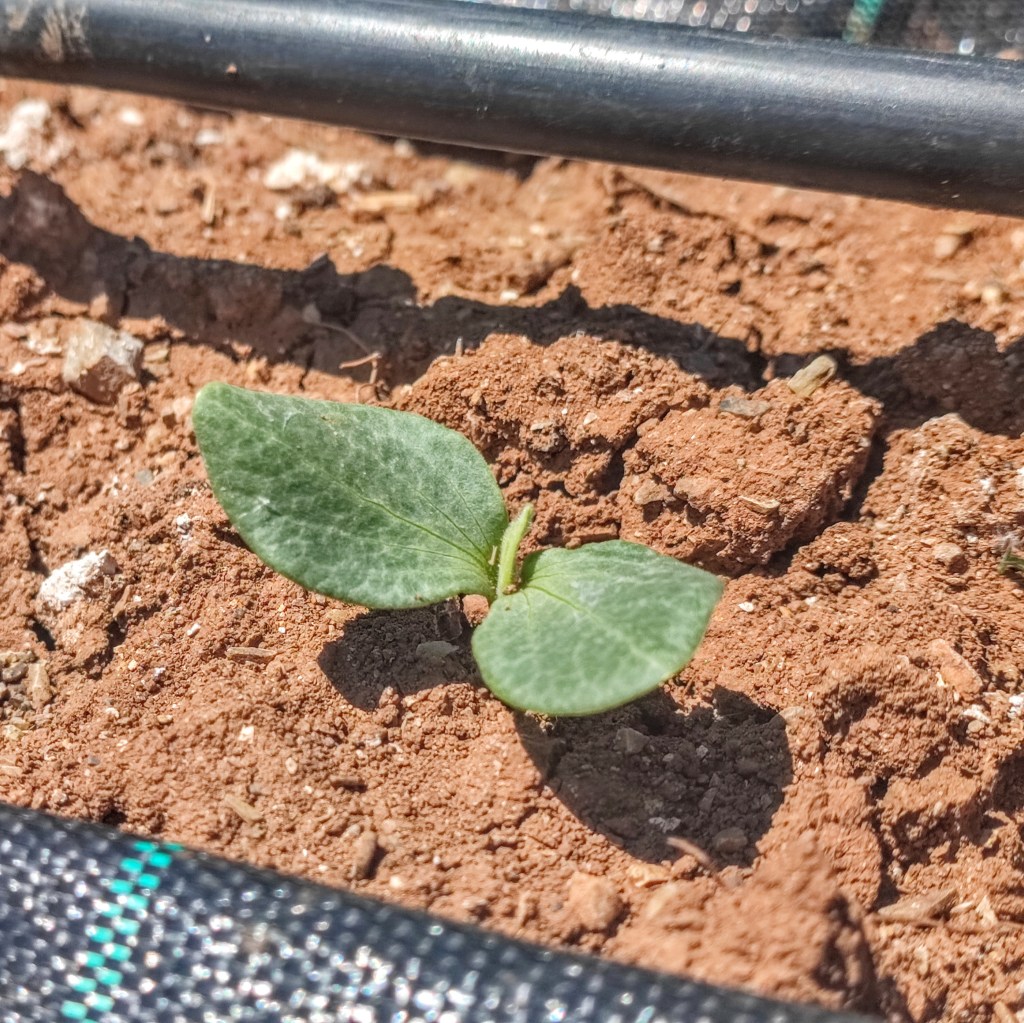
On deck this year, and in no particular order, are beets, leeks, red Tropea onions, okra, two types of zucchinis, two types of butternut squash, cardoons, and assortment of cutting flowers. In pots I’m growing special pointed cherry tomatoes from Naples called “Pomodoro cirio”. Last summer a “pizzaiolo” (a person who makes pizza) gave me a little basket of the tomatoes and I harvested the seeds. The seedlings are about an inch tall and will need thinning soon. I choose to plant them in pots so that I can tightly net them once they bear fruit. No stink bugs will outsmart me this year! In the meantime, make some SAUERKRAUT!
___________________________
Did you enjoy reading or making the recipe from this post? If so, please consider giving it a “like” or a comment. It would be nice to know you are out there and that my posts connect with you.
Ingredients
- 2 pounds (1 kg) white, pale green or red cabbage (Do not use Nappa Cabbage. Choose a tight leaf version)
- 4 teaspoons fine sea salt or kosher salt (for the love of God, do not use iodized table salt!). General rule of thumb for sauerkraut: Use 2 level teaspoons of salt for every pound (16 ounces) of shredded cabbage
- 1/2 teaspoon whole black peppercorns
- Optional: either 1/2 teaspoon caraway seeds, a couple of bay leaves, or 1/4 teaspoon smoked paprika
Directions
- Remove any loose outer leaves of the cabbage and discard. Cut the cabbage in half and remove and discard the core. Using a sharp knife or a food processor with a slicing disc, slice the cabbage VERY finely and place it into a large mixing bowl
- Add the salt to the cabbage and mix thoroughly. Begin roughly massaging the cabbage, as if you’re mad at it. Squeeze it hard in your hands until your knuckles turn white and continue this madness for 5 minutes. DO NOT DRAIN any liquid – you’ll want as much as possible. Let the cabbage rest for 5 minutes and then repeat with another 5-minute brutal massage. Add the black pepper corns and/or caraway seeds at this point and mix to distribute them evenly. If you want to use smoked paprika, you can add this after the fermentation process is done 7 – 10 days from this point, before you put it into their final jars
- Choices: you will be covering and stirring and re-covering and re-stirring this every day for the next 7 – 10 days. It only takes a minute, so it definitely sounds more cumbersome than it is. I choose to put all the cabbage and its liquid in a super large bell jar. I find it’s easier to stir and cover this way. If you prefer to distribute the cabbage and its liquid into several smaller jars, go a head and do so, I personally think it’s more work
- Keep the cabbage covered with liquid and parchment. If your cabbage didn’t produce enough liquid to cover the cabbage once it’s in a jar, fret not. You can make a brine solution of with one teaspoon fine sea salt of kosher salt dissolved into 1 cup water. Press the cabbage down into the jar(s) and cover it with parchment paper (I crinkle my parchment up so it’s more mailable), followed by a sealable lid. Store the jar in a cool, dark place
- Stir and cover, stir and cover: The next day, uncover the cabbage and give it a good stir. I find using a rubber spatula works well so I can also scrape down the sides of the jar). Re-cover the cabbage with a fresh piece of parchment and re-cover the jar with its sealable lid. I know, it stinks, doesn’t it? That means the fermentation process is well under way, ever after only a day. Repeat this process for 7 – 10 days. Start tasting the sauerkraut at day 7. When you taste that it is ready, transfer it into individual jars and store it in the refrigerator. This should keep for several months

 Greg Nelson Cooks
My mother was German so I ate my share of kraut. And I am familiar with how it can interact with one’s body. Beans and kraut together should maybe carry a warning to stay close to home and perhaps enjoy alone.
LikeLiked by 1 person
Bean and Kraut! LOL. The importanat thing is that it will be good, even if you eat alone and at home.
LikeLike
Perfect timing! I was craving some good old fermented veg. I have wonderful memories of my Mom massaging cabbage on our kitchen countertop to make “kapusta” to go with the “kielbasa”. It’s a natural probiotic and an amazing gut-healer. Can’t wait to try your method. Sorry about your cherries!
LikeLiked by 1 person
I love how our various senses help create and maintain memories. I hope you make this and it’s as good as you remember!
LikeLike